
The 3 things every hypnotherapy practice needs to get clients
Most hypnotherapists are good in the room and quiet in the diary. That's rarely about skill. Here's the whole client-getting system, end to end, in plain English.
Traffic
People who need help can find you.
Pillar 2An offer and a page
That make the next step easy.
Pillar 3Fast follow-up
Every enquiry hears back straight away.
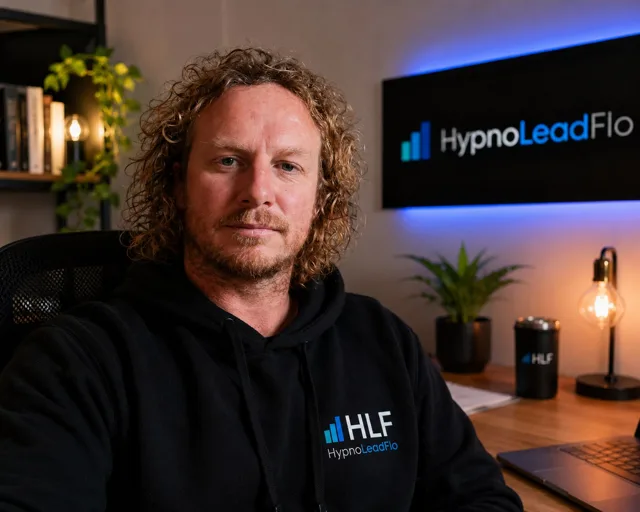 James Brine, HypnoLeadFlo12+ years helping hypnotherapists get booked
Why good therapists have quiet diaries
Training covers how to help a client once they're sitting in front of you, and very little about how that client finds you in the first place.
I've spent more than 12 years doing one thing: helping hypnotherapists get booked, mostly through Google. Most of that work has been with anxiety practices in Australia, the UK, the US and Canada. Across all of it, the practices that fill their diaries have the same three things in place: traffic, an offer and a page that make the next step easy, and fast follow-up.
If any one of the three is missing, the other two don't work very well.
A great page with no visitors is silent.
Nobody sees it, so nobody enquires.
Lots of visitors on a confusing page is wasted money.
People have to think too hard, so they leave.
A good enquiry that waits a day often goes elsewhere.
Someone else replied first.
Everything below is something you can set up yourself. None of it is complicated. It just needs doing properly, and in the right order.
Traffic: somebody has to find you
There are free ways and paid ways, and each one has a catch. Tap through each source for an honest comparison.
Referrals and word of mouth
Social media
SEO (ranking on Google for free)
Facebook and Instagram ads
Google Ads
See all five side by side
| Source | Cost | Speed | The catch |
|---|---|---|---|
| Referrals and word of mouth | Free | Slow | You can't turn it up when the diary is empty |
| Social media | Free (your time) | Slow | Months of regular posting, and people are scrolling, not searching |
| SEO (ranking on Google for free) | Free-ish | 6 to 12 months | Competitive, and slow to build |
| Facebook and Instagram ads | Paid | Medium | You're interrupting people who weren't looking for help |
| Google Ads | Paid | Days | It costs money, and it needs managing |
Why I work on Google
The reason is intent. Someone typing "hypnotherapy for anxiety near me" into Google isn't idly scrolling. They're looking for help, often today. You're not trying to convince them they have a problem. You're just making sure you're the person they find.
That's why Google can work quickly. It's also why it can waste money quickly if it's set up loosely.
Someone searching like this wants help now. That's intent.
If you run Google Ads yourself
You don't need anything fancy, but a few principles matter a lot. Tick them off as you go (saved on this device only).
The shape of a simple campaign
Just the structure. Keep it this simple to begin with.
If you'd rather start free
That's fine. Pick one free channel and do it consistently rather than five channels badly.
Google Business Profile
Complete it, with your real service area, photos and reviews. Ask every happy client for a review.
Therapist directories
Get listed on the main directories in your country, and link each listing to your page.
Tell your network
GPs, psychologists, counsellors and other practitioners can be good referrers once they know what you do and who you help.
Free channels are slower, but they add up. Whatever you choose, everyone you send should end up on a page built to turn them into an enquiry.
An offer and a landing page
Traffic is useless if it lands on a page that makes people think too hard. A typical homepage tries to do everything: your story, every issue you work with, your fees, your training, a blog. A visitor who is anxious and searching for help has to work out where to start, and many simply leave.
What works better is one offer and one page built to make one decision easy.
1. One problem, one page
If they searched for help with anxiety, the page is about anxiety, and only anxiety. Give smoking or weight their own pages.
2. A low-risk first step
A free consultation, a free assessment, or a free relaxation audio. Not a six-session package from a web page.
3. Proof without clicking
Reviews and short video testimonials people can see as they scroll. Never hidden behind "click to load".
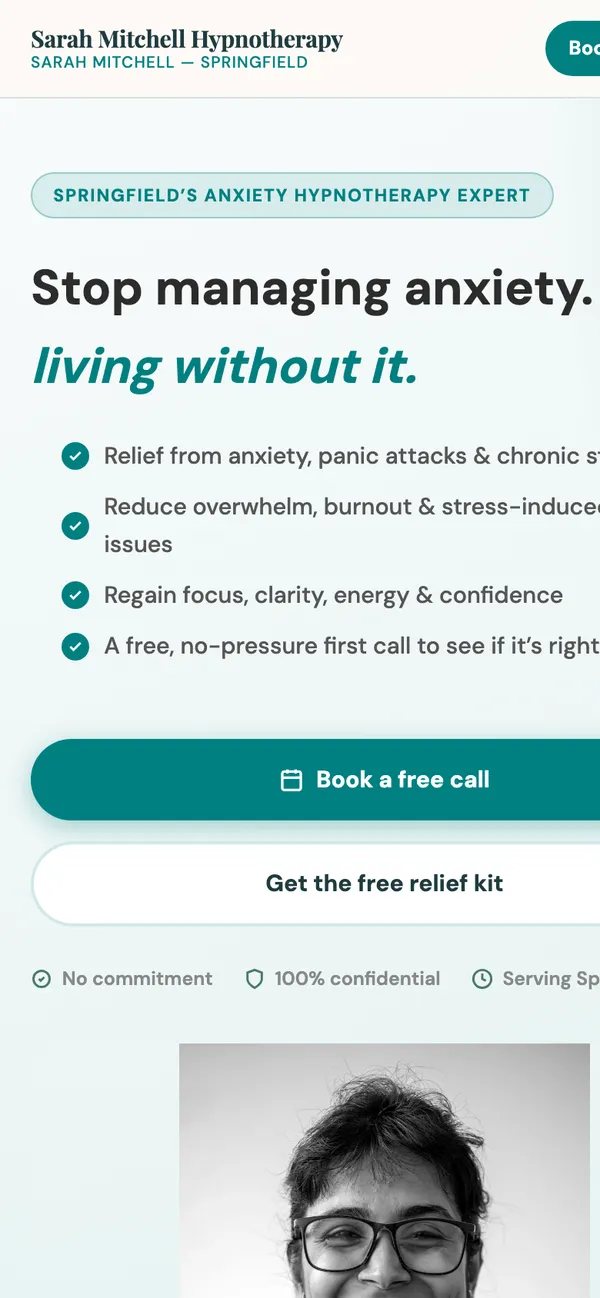
4. Fast and clear on a phone
Most people searching for help are on their phone. Check yours with the list below.
The first step's job is to start a conversation. The selling happens later, on the call, once they've met you and trust you. And real words from real clients will do more than anything you write about yourself.
What each part of the page is doing
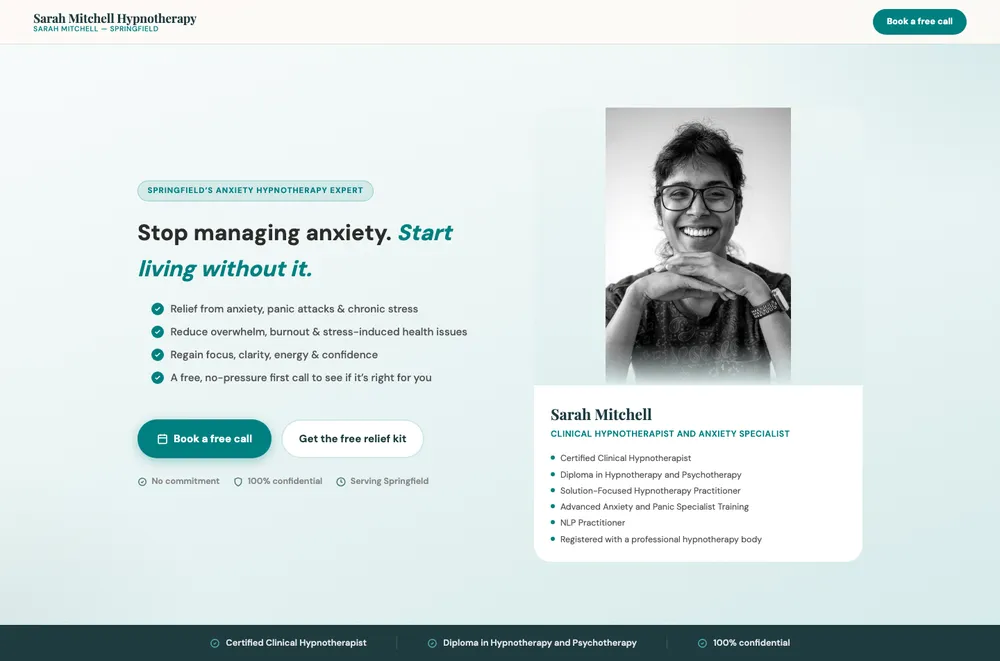
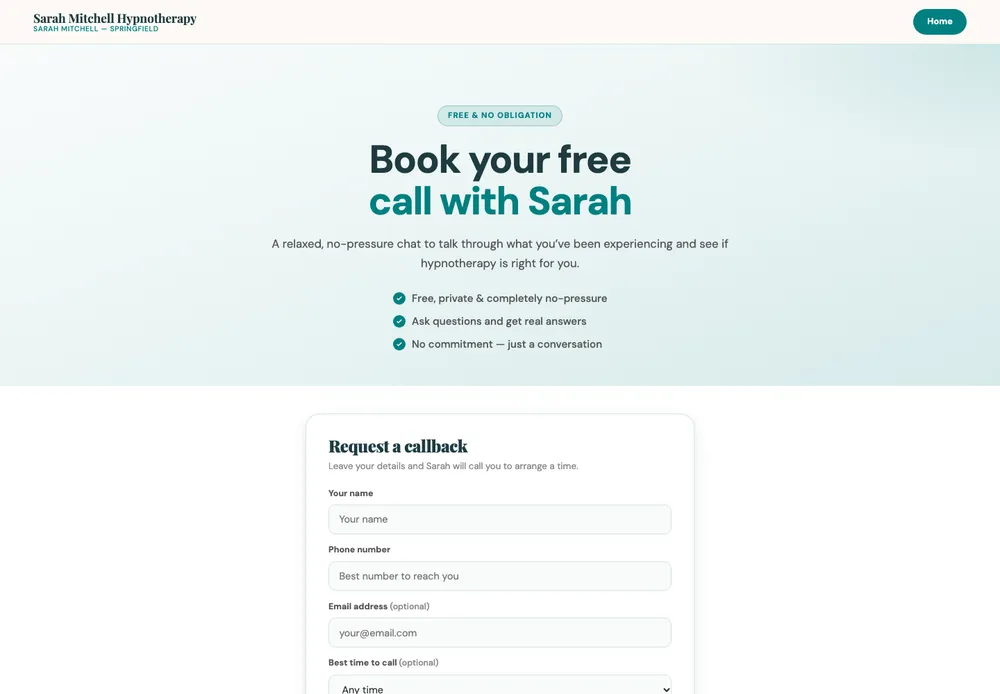
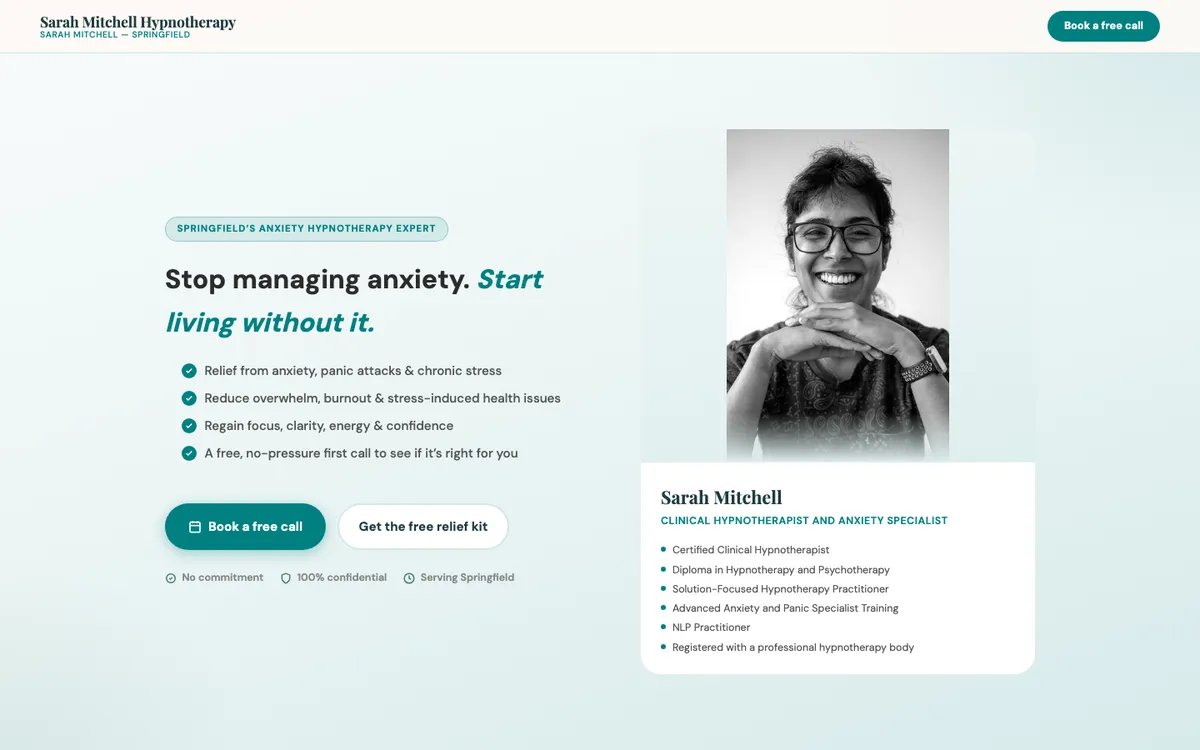
Screenshots from the example free graduate page (made-up therapist "Sarah Mitchell"). Tap a section, then click any image to enlarge.
 12345
- Headline names the problem and the outcomeAnxiety, and life without it. Nothing else competes for attention.
- Short, warm bulletsWhat they'll get, in their words.
- The offer and the button, near the topA free call, plus a softer option: the free relief kit.
- A real personPhoto, name and qualifications build trust before they scroll.
- Trust stripQualifications and "100% confidential" in one line.
 12
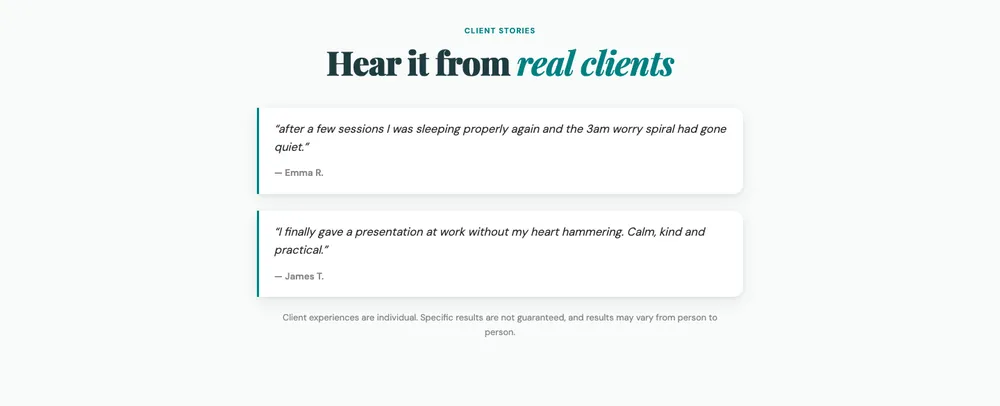
- Proof gets its own section"Hear it from real clients", high on the page.
- Visible without clickingWritten quotes and video testimonials are on the page as people scroll. The example uses sample text; your page uses your real reviews.
 12
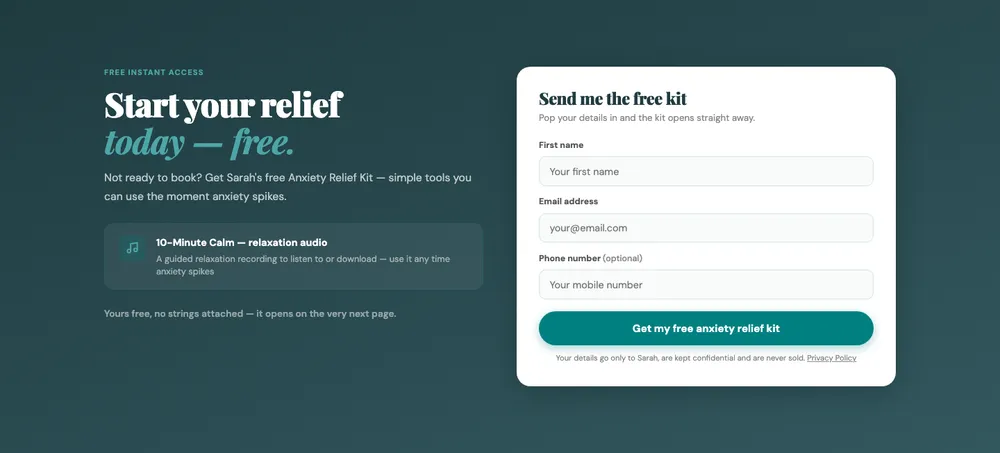
- A low-risk first stepA free relaxation audio and video tips, for people not ready to book yet.
- A short formFirst name and email, with phone optional. Every extra field costs enquiries.
 12
- Reassurance firstFree, private, no pressure, no commitment.
- A simple way to bookTheir own calendar if they have one, or a callback request like this one.
A simple layout that works
You don't need to reinvent anything. A page that works well usually runs in this order.
The shape is the easy part. What makes one page convert better than another is the wording and the testing behind it, so treat your first version as a starting point and keep improving it.
Check your page on your own phone
Open it on your phone and tick each one off.
What visible reviews look like
An example layout with made-up sample text, not HypnoLeadFlo's reviews. On your page, use your own real Google reviews and testimonials, shown as people scroll.
Sample review: after a few sessions I was sleeping properly again and the 3am worry spiral had gone quiet.
Sample review: calm, kind and practical. I finally gave a presentation at work without my heart hammering.
Want this page built for you? As a graduate of your training, you can have one built free, using the same design our paying clients use.
Get your free pageFast follow-up and booking
This is where most therapists lose the client, and it's the easiest pillar to fix.
Picture this. Someone fills in your form at 9pm on a Sunday. They're anxious, they've finally worked up the courage to reach out, and they've probably looked at two or three other therapists too.
The slow reply
- Form sent. Nothing comes back.
- They try another therapist, who replies by text in a minute.
- You call back. They've already booked elsewhere.
The instant reply
- Form sent. An email arrives with their free audio and a booking link.
- A friendly text from you: did it come through ok?
- They pick a time in your calendar themselves.
Speed is the cheapest improvement you can make. It doesn't cost more in ads. It just means the enquiries you already get turn into more bookings.
Hi Alex,
Thank you for taking the first step. I know how overwhelming this can feel, and I want to reassure you that change is absolutely possible.
Here are your gifts to start calming your mind immediately:
- 🎧 Relaxation and anxiety relief hypnosis MP3
- 🎥 Anxiety relief and mental reset videos
- 📞 A one-on-one phone or Zoom consultation with me
Kind regards,
Sarah Mitchell
An instant email, sent the moment the form arrives. Wording from HypnoLeadFlo's own follow-up template, shortened. Names are examples.
Texts from the same template. Names and the reply are illustrative.
What good follow-up looks like
- An instant text message. Thanks for reaching out, here's what happens next, and here's a link to book a time.
- An instant email saying the same thing, with the booking link and anything you promised, such as the free audio.
- A simple booking link. They choose a time in your calendar, shown in their own time zone, with only slots you'll genuinely be available for.
- Reminders by email and text, so fewer people forget.
- A short follow-up sequence for people who didn't book straight away. A few kind, helpful messages, not pressure. Many people book on the second or third nudge simply because life got in the way the first time.
If you're doing it by hand
You can do all of this manually to begin with.
When the manual version starts to slip, which it will once you're busy with clients, that's the point to automate it. Automation means every enquiry gets the same fast, friendly response at 9pm on a Sunday while you're with a client or asleep.
The order matters
Build the page first
One problem, a low-risk offer, visible proof, and a short form or booking link.
Set up follow-up second
Even a manual process with saved messages is fine to start.
Then send traffic
Free, paid, or both. Track what brings enquiries and do more of that.
Find your bottleneck
Check your numbers every couple of weeks: how many visitors, how many enquiries, how many bookings, how many become clients. Then pick what's true for you.
An honest note
None of this guarantees a full diary, and results vary a lot by area, competition and budget. But in my experience, practices with all three pillars in place do far better than practices relying on one.
I hope this helps you build it.
James Brine, HypnoLeadFlo
Get your landing page built, free
As a graduate of your training, you can have a landing page built for you free of charge, using the same design our paying clients use.
- Your landing page, written around your practice
- A free gift page for your relaxation audio and YouTube playlist
- A booking page, with your calendar or a callback form
- Your own privacy and terms pages, and enquiries emailed to you
No card, no contract. And if you'd later like the follow-up handled for you, HypnoLeadFlo's software (CRM, booking calendar, Google reviews on your page and automated follow-up, US$97 a month) is there whenever you're ready. No pressure either way.
Ask James
Stuck on any of this, or not sure where to start? Send me a question and I'll reply personally.
Thanks, your question is with James.
He'll reply by email, usually within 2 business days.